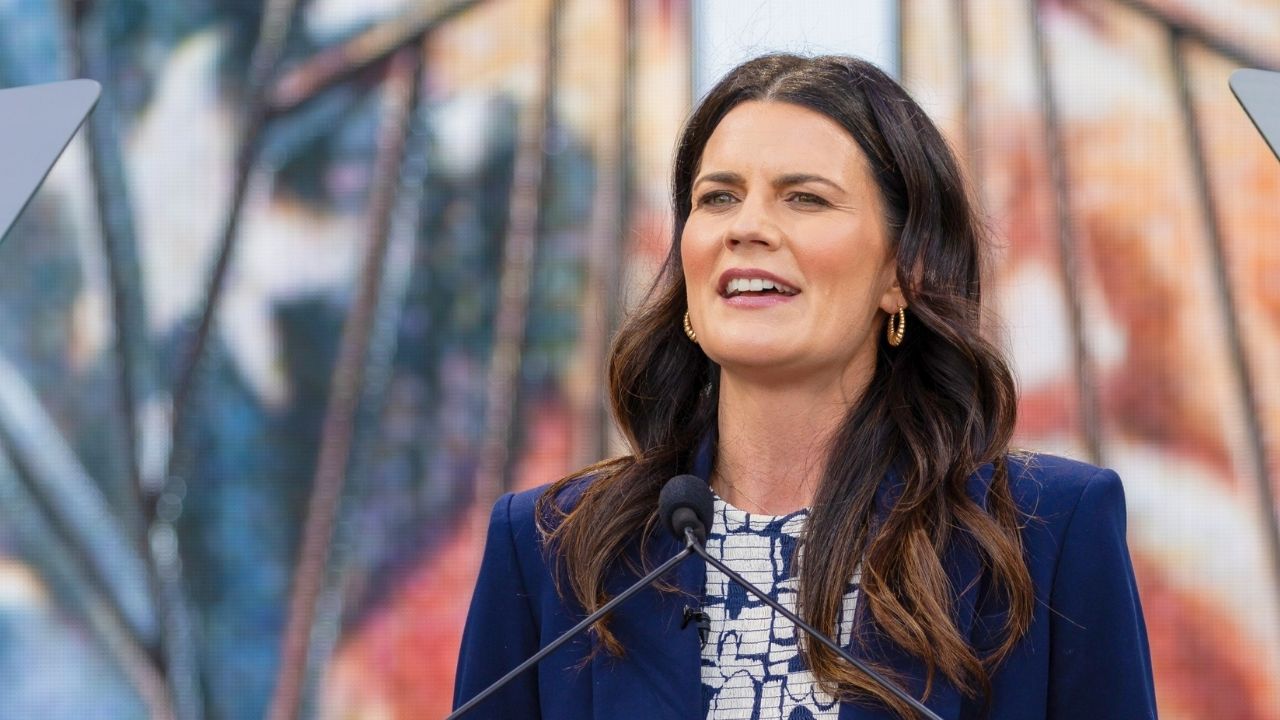
Billy Graham brought spiritual counsel to presidents. Franklin Graham brought prayer and a forceful public voice to the political arena. Now Franklin’s daughter could enter government with a diplomatic assignment of her own.
President Donald Trump has nominated Cissie Graham Lynch, Billy Graham’s granddaughter, to become U.S. Ambassador at Large for International Religious Freedom. The Senate’s nomination list records the nomination under Jane Lynch, of North Carolina, with a September 14 referral date. Senate confirmation is still required.
“I would consider it a great honor and privilege to do so,” Lynch posted on X, asking for prayer that, if confirmed, she would serve with excellence and protect religious freedom.
President Donald Trump has asked me to serve as the U.S. Ambassador at Large for International Religious Freedom.
I would consider it a great honor and privilege to do so.
If confirmed by the Senate, please pray that I would serve with excellence and make the most of every…
— Cissie Graham Lynch (@CissieGLynch) September 15, 2026
Her father pointed to her international experience in his own announcement on X.
“Cissie is uniquely qualified for this—she has traveled the world and been a student of this issue for many years,” Franklin Graham posted. “She has a broad worldview and knowledge of the issues facing religious freedom today.” He added: “I couldn’t be more proud of her, and I ask you to pray that God would give her wisdom and strength.”
President @realDonaldTrump has nominated my daughter @CissieGLynch to serve as the United States Ambassador at Large for International Religious Freedom. Cissie is uniquely qualified for this—she has traveled the world and been a student of this issue for many years. She has a… pic.twitter.com/hPJEwVWwXm
— Franklin Graham (@Franklin_Graham) September 15, 2026
The development extends a family history spanning generations of American leadership. It also changes the nature of the relationship: a Graham descendant could move from offering counsel to exercising the responsibilities of a Senate-confirmed office.
A Ministry That Crossed Party Lines
Billy Graham’s presidential relationships reached well beyond one administration or political party. His official obituary says he prayed with every U.S. president from Harry S. Truman through Barack Obama.
That span included Democrats Truman, John F. Kennedy, Lyndon B. Johnson, Jimmy Carter, Bill Clinton and Obama; and Republicans Dwight D. Eisenhower, Richard Nixon, Gerald Ford, Ronald Reagan, George H.W. Bush and George W. Bush.
Those relationships varied. Meeting or praying with a president did not necessarily make Graham that president’s regular spiritual adviser, much less a member of the administration. His influence often rested on personal trust.
For George W. Bush, the connection preceded the presidency. In a 2018 personal remembrance, the Republican former president traced their relationship to 1985 and credited Graham’s teachings with helping begin his faith journey and helping him quit drinking.
Bush’s statement released through his Dallas-based presidential center captured that influence: “His love for Christ and his gentle soul helped open hearts to the Word, including mine.”
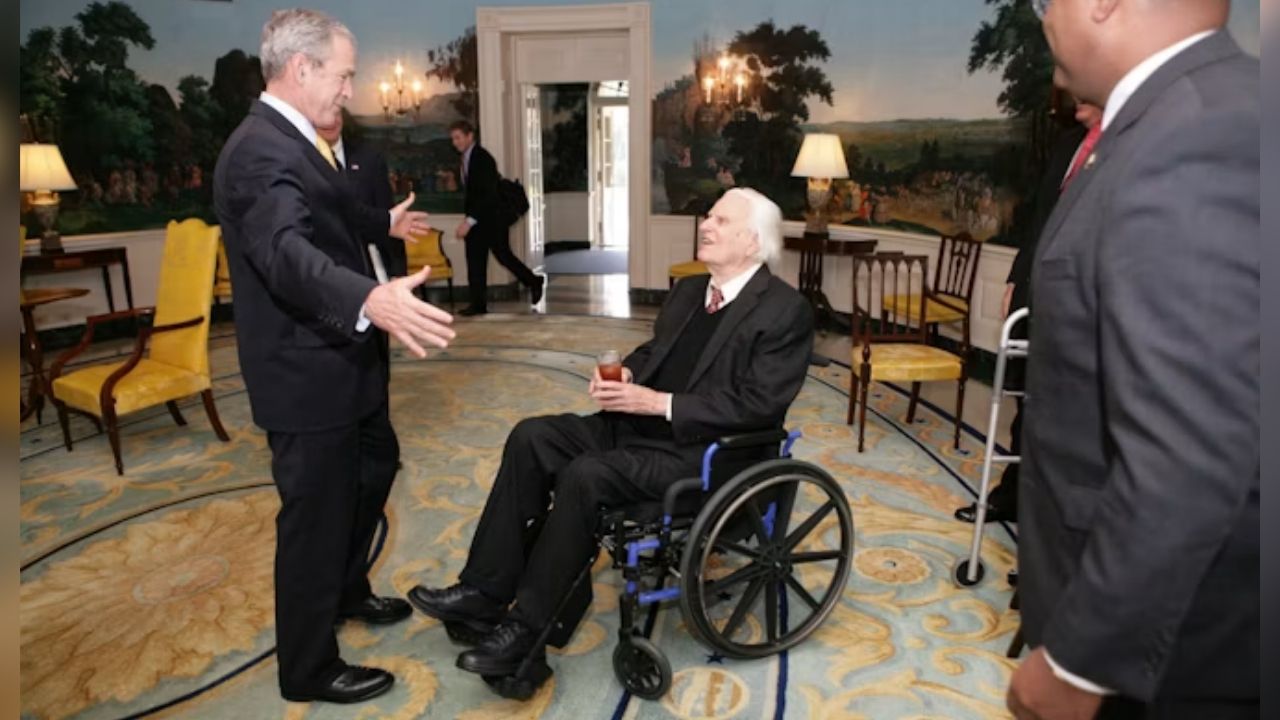
President George W. Bush with the Reverend Billy Graham | Image courtesy of the George W. Bush Presidential Center
Graham offered inaugural prayers for Republican George H.W. Bush in 1989 and Democrat Bill Clinton in 1993. At Clinton’s inauguration, he asked God to guide the incoming president and Vice President Al Gore: “Help them always to see the office to which they’ve been elected as a sacred trust from you.” The words are preserved in the ministry’s collection of inaugural prayers.
After the September 11, 2001, terrorist attacks, Graham spoke at Washington National Cathedral, offering spiritual consolation to a country confronting mass death and uncertainty, as his official obituary recounts.
The Cost Of Getting Close
The history was not free of political entanglement.
Graham’s friendship with Republican Richard Nixon extended into campaign politics. As PBS’s American Experience recounts, Graham offered Nixon advice about reaching Christians during his presidential campaigns and publicly vouched for his character.
Watergate and the release of Nixon’s recordings exposed the hazards of that closeness. Graham later expressed regret about his political involvement, telling Christianity Today he “would have steered clear of politics,” according to the PBS account.
That experience complicates any portrait of Graham as a figure who remained entirely above partisanship. He ministered across party lines, but he also made political judgments and came to question some of them.
The distinction matters for his descendants: praying for a leader, endorsing a leader’s policies and serving in that leader’s administration carry different responsibilities.
Franklin’s Public Voice, Cissie’s Next Step
Franklin Graham has continued the family’s presence at presidential ceremonies. He participated in the inaugurations of Republicans George W. Bush in 2001 and Donald Trump in 2017 and 2025, according to the Billy Graham Evangelistic Association.
At Trump’s second inauguration, his words included both prayer for presidential guidance and a public affirmation of Trump’s return. He attributed Trump’s survival of an assassination attempt to God, as Decision’s account of the prayer reports.
Lynch has her own record of religious and political engagement. She spoke at the 2020 Republican National Convention. During Trump’s first administration, she served on the Executive Evangelical Advisory Board of his Faith Advisory Council, according to Decision, published by the Billy Graham Evangelistic Association.
The Religious Freedom Institute, which welcomed her nomination, says her work with Samaritan’s Purse since 2010 has included service as a senior adviser and ministry spokesperson.
Her proposed assignment would require turning advocacy into diplomacy.
The International Religious Freedom Act of 1998 established the ambassador’s office within the State Department. The position advises the president and secretary of state on religious freedom abroad and helps direct the government’s response to persecution.
Its mandate extends to Christians, Jews, Muslims, members of other religions and people who profess no religion. The law explicitly recognizes the protection of both theistic and non-theistic beliefs.
For Lynch, that would mean representing a universal right while serving an administration led by a Republican president she has publicly supported.
Her grandfather’s presidential ministry depended heavily on the confidence of individual leaders. The office she seeks carries a broader public obligation: defending the freedom of people whose beliefs may differ profoundly from her own.
For now, the nomination remains before the Senate Foreign Relations Committee. Confirmation would place a third generation of the Graham family in a new relationship with the presidency: holding a diplomatic office charged with protecting religious freedom abroad.
Provided by Dallas Express