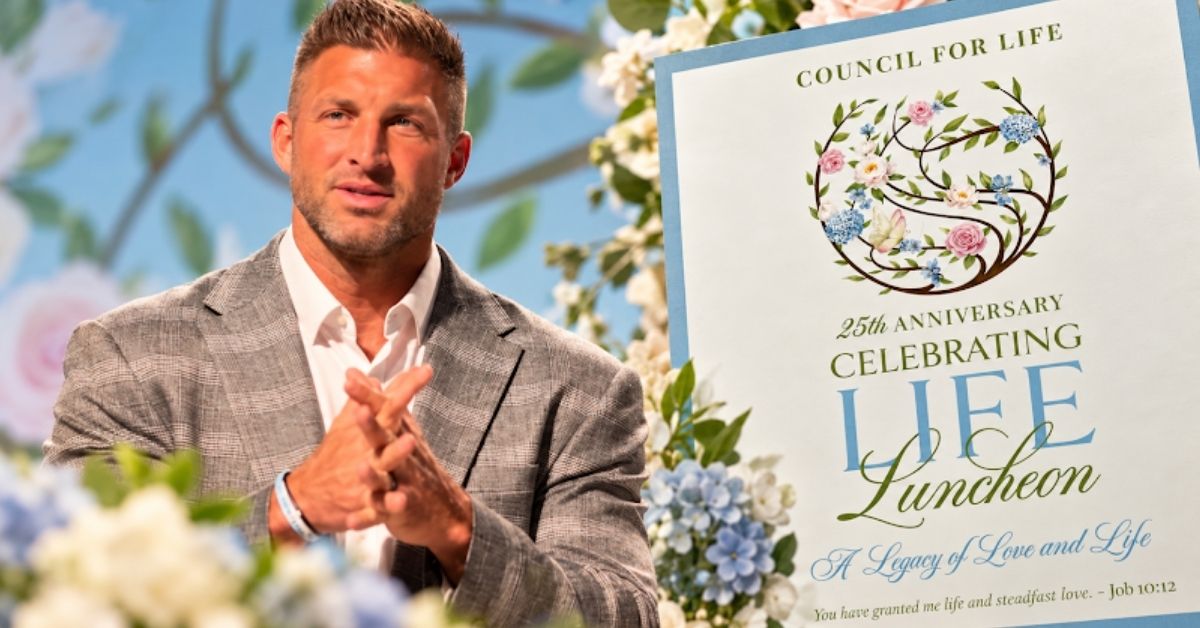
What happens when 1,500 influential people gather in one room and are challenged to give more than their money, time, or applause? Tim Tebow wants to know.
At Council for Life’s 25th anniversary luncheon Thursday at the Hilton Anatole, the former NFL quarterback, Heisman Trophy winner, and Christian humanitarian delivered a powerful challenge about faith, sacrifice, and protecting vulnerable lives.
“How valuable are the vulnerable to us?” Tebow asked. “Just valuable enough to get leftovers?”
He challenged attendees to examine whether their greatest investments of time, energy, and resources were directed toward what mattered most. For Tebow, that question was personal. He had dedicated years of extraordinary discipline and sacrifice to football. But what if that same commitment were directed toward protecting human life?
For me, his message reached into one of the most painful chapters of my life.
Twenty-Five Years of Showing Up
The luncheon celebrated 25 years of the Council for Life, founded in 2001 by 11 Dallas women committed to supporting women, families, and unborn children. The anniversary honored those whose leadership established and sustained its mission, including Founder Emeritus Ann Carruth, who received a special award presented by fellow founder and board member Lisa Troutt. Ann and her husband, David, also served as honorary chairs, while Stephanie Baker and Lynne Schott co-chaired the luncheon.
The organization reported that its supported pregnancy centers have helped more than 100,000 mothers choose to continue their pregnancies over its 25-year history. This year’s fundraising effort supports 33 beneficiaries, with a goal exceeding $2 million. Council for Life projected its grants would help support more than 78,000 pregnancy-center visits in 2026.
Attendees also learned of a generous $250,000 matching grant from The Lunsford Foundation to encourage additional contributions.
But Tebow challenged the room to think beyond fundraising totals. He shared a story about a young man facing jail time whose seven friends showed up at his courthouse hearing and remained there all day. According to Tebow, the judge was so moved by their presence that he allowed the young man to go home. The young man celebrated his freedom. Tebow asked how many other lives might be changed simply because someone was willing to show up, and then take action.
His message was unmistakable: Showing up matters. But what we do after showing up matters even more.
When Football Becomes the Lesser Calling
Tebow recalled seeing crowds in New York City eagerly waiting to participate in an immersive Batman experience. People were willing to spend substantial money, time, and energy helping a fictional superhero save the day.
He admitted he wanted to participate, too. Then came the realization: People were enthusiastically investing in a fictional rescue mission while real human beings were suffering.
His point was not that entertainment or sports are inherently wrong, but that our priorities reveal what we truly value. He also recalled attending the Broadway musical Hamilton with his future wife, Demi-Leigh, and being moved by its portrayal of Alexander Hamilton’s relentless dedication.
The performance prompted him to consider whether he had ever worked as tirelessly for his Christian calling as he had for football. “I would say one of the most disappointing things about my life is my greatest effort has been for a silly game,” Tebow told the audience.
His hope was that his greatest dedication would ultimately be remembered not for football, but for serving Christ and humanity.
The Birth Story That Changed Everything
One of the luncheon’s most emotional moments came when Tebow recounted the circumstances surrounding his own birth. His parents were missionaries overseas when his mother experienced serious pregnancy complications, including severe illness and periods of unconsciousness.
According to Tebow, physicians warned that continuing the pregnancy posed significant risks. His parents chose to continue, and he described his survival as miraculous. He recalled a physician expressing astonishment that he had survived.
For Tebow, his birth story is inseparable from his faith and his conviction about the value of human life. He also recounted a disturbing secondhand testimony from a former abortion counselor who said she had witnessed a second-trimester abortion. Tebow used the account to challenge adults, particularly men, to assume greater responsibility for protecting and supporting vulnerable children and families.
His message returned repeatedly to a central conviction: Those most in need of protection should not be left to fight alone.
The Part of This Story I Never Imagined Sharing
As I listened to Tebow, I became overwhelmed with emotion. Not because I disagreed with his message. Because I understood it through a painful experience of my own.
I had an abortion when I was 15 years old.
I knew Jesus then. But I also remember the horror of walking into that abortion clinic with the mother who raised me. I remember what happened. And I remember the shame that followed.
Two years later, at 17, I discovered that I had been adopted. My biological mother had chosen to carry her pregnancy and place me for adoption. Suddenly, I was confronted with a realization that would take me years to understand.
My biological mother had given me the opportunity to live, and I had made a different decision when faced with my own pregnancy.
That revelation compounded my grief and shame. For decades, those feelings affected my life in ways difficult to explain. Healing required years of personal work, spiritual reconciliation, and even inpatient treatment during a particularly difficult period.
I do not share this because every woman who has experienced abortion feels the same way. Women have different experiences, and their circumstances deserve compassion. I share it because this was mine. And because I know there are women who carry painful memories in silence, convinced that their past has forever defined their worth.
“You’re Welcome Here”
Something extraordinary happened before Tebow even took the stage. Council for Life’s opening remarks included a message of welcome to women who had experienced abortion.
I cannot adequately describe what that meant to me. In a room gathered around the conviction that unborn life deserves protection, there was also recognition that women with painful histories belong in conversations about faith, compassion, and healing.
I had once carried so much shame that I could scarcely have imagined sitting in such a room. Yet there I was, surrounded by friends. Not hiding. Not pretending my past did not exist. And no longer allowing it to define my future. My faith teaches the importance of repentance, reconciliation, mercy, and forgiveness.
I believe sin has spiritual consequences. But I also believe, with all my heart, that God’s mercy is greater than the sins we bring before Him.
The road to accepting that mercy has been long. And I have come to understand something I wish I had known as a frightened teenager:
Shame does not have to win. Jesus can win. Forgiveness can win. Reconciliation can win.
No one should believe that a painful decision has placed them permanently beyond God’s love.
Compassion Is Not Comfortable
Near the conclusion of his address, Tebow made a distinction that struck me deeply. Sympathy and empathy, he explained, can exist at a distance.
Compassion demands more. He described compassion as caring enough about another person’s suffering to be willing to suffer alongside them. That requires more than agreement, financial support, or public declarations. It requires action.
For organizations serving pregnant women and struggling families, that means practical assistance, emotional support, and ongoing relationships. For individuals, it means showing up even when circumstances are complicated or uncomfortable. And for women carrying grief or regret, it means offering a place where they can speak without being reduced to the most painful decision of their lives.
Tebow challenged the audience to stop postponing meaningful service until some imagined future moment when life becomes less busy. His question was whether the people in that ballroom would act now.
A Legacy of Life and a Message of Redemption
As the luncheon concluded, Council for Life emphasized its continued work supporting women, children, and families across North Texas.
The organization’s fundraising appeal focused on expanding support through its 33 beneficiaries, with the $250,000 matching grant offering donors an immediate opportunity to contribute. But perhaps the most important question raised that day cannot be answered by fundraising totals.
What does it mean to truly value another human being?
Does that value extend to the unborn child? The mother facing an unexpected pregnancy? The woman who made a decision years ago and still struggles with it? The family needing support long after a child is born?
For me, compassion must be large enough to include all of them. I left the luncheon profoundly grateful. Grateful for the women who built the Council for Life and sustained its mission for 25 years. Grateful for Tebow’s willingness to speak openly about his faith and challenge influential people to examine their priorities.
But most of all, grateful to God. Because at 15, I could never have imagined the journey ahead of me. At 17, discovering I was adopted, I could not have anticipated how deeply that revelation would shape my life.
And during the years when shame seemed impossible to escape, I could never have imagined sitting in a room like that one, listening to a message about the value of life and feeling something other than condemnation.
I felt gratitude. I felt the extraordinary gift of reconciliation. And I believe the Holy Spirit was working powerfully through Tebow’s words today.
For anyone who has allowed guilt, regret, or shame to convince them that their story is over, I want you to know something. It isn’t. There is still room for healing. There is still room for forgiveness. There is still room for redemption.
Your past may be part of your testimony. It does not have to be the end of your story. And that, perhaps, is the greatest rescue mission of all.
Provided by Dallas Express