President Donald Trump wants a new name for artificial intelligence.
But perhaps the word he wants to replace is the very word Americans should be thinking about.
Artificial.
Trump recently floated “Super Intelligence” and “Superior Intelligence” as alternatives to AI on Truth Social.
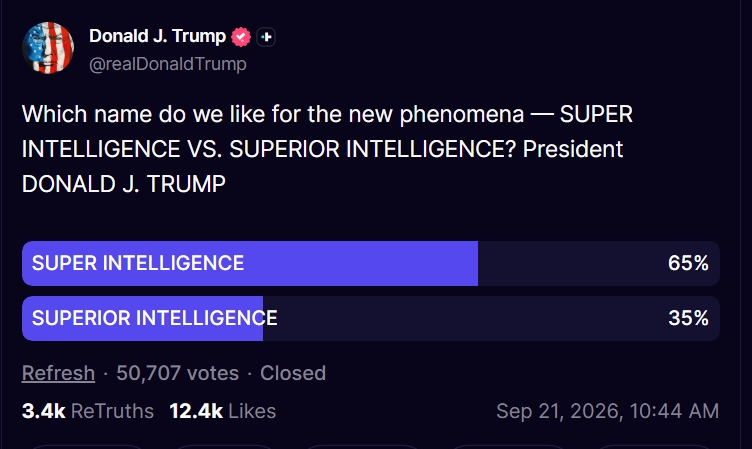
Then, during his September 22 address to the United Nations, he brought the terminology onto the world stage.
“The United States totally rejects any attempt to construct a globalist scheme of control for the Artificial Intelligence being spoken of so much now — hereinafter officially called ‘Super Intelligence,’” Trump said, according to the White House.
Whatever terminology ultimately catches on, the discussion raises a much larger question: What happens when an increasingly artificial world begins to feel indistinguishable from reality?
Not because humanity has been proved to live inside a computer simulation.
But because, piece by piece, we may be constructing something that increasingly resembles one.
A Matrix Without The Machines
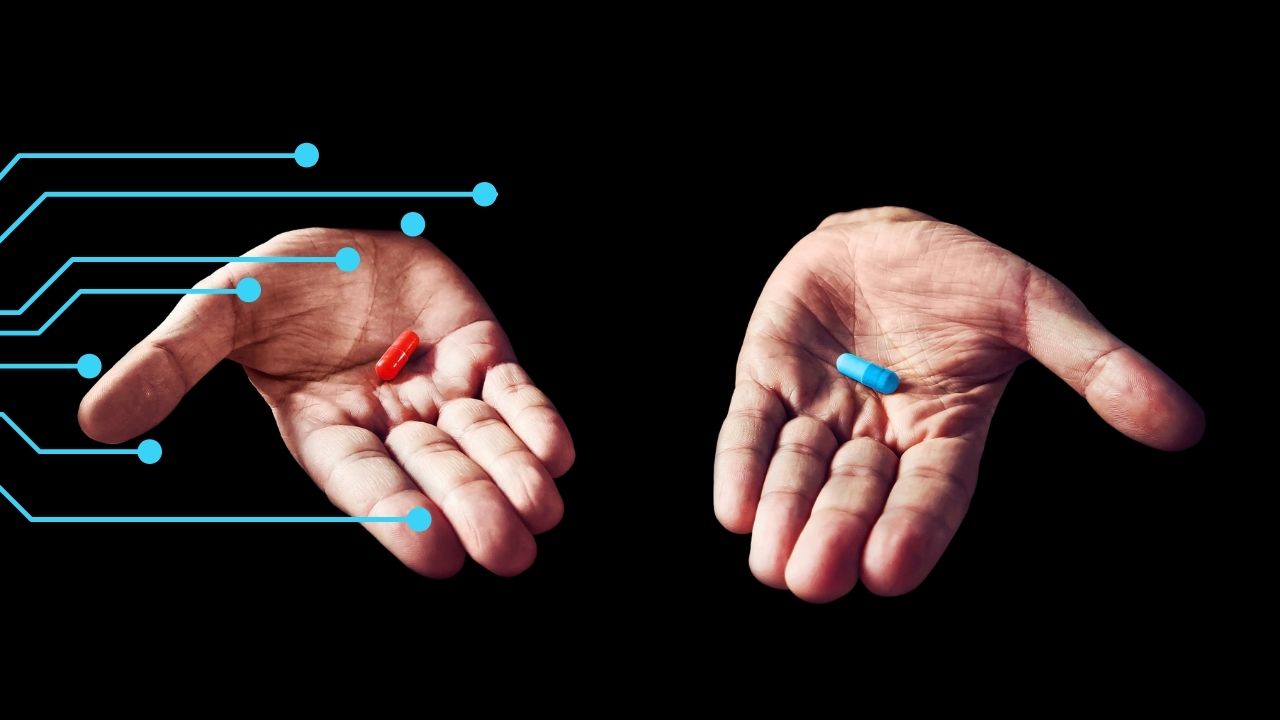
The modern Matrix may not require computer pods, cables running into human brains or a choice between a red pill and a blue one.
It can fit in a pocket.
Phones increasingly mediate how people encounter the world. Algorithms help decide which stories, advertisements, arguments, photographs and videos rise to the top of a feed.
Cameras automatically enhance photographs.
Editing software can erase unwanted people, replace skies, smooth faces and reconstruct missing parts of an image.
Generative AI can create realistic photographs of events that never happened and voices belonging to people who never spoke the words being heard.
The philosophical question, therefore, may no longer simply be: Are we living inside a simulation?
It may instead be: How much of the reality we experience is being constructed for us… or by us?
Behavioral expert Chase Hughes explored a related idea in his online presentation, “I’ll Prove It — THE SIMULATION IS REAL.”
Hughes’ discussion should not be confused with scientific proof that humanity inhabits a literal computer simulation. No established scientific evidence demonstrates that proposition.
What research does demonstrate, however, is almost as fascinating: Human beings experience far less of objective reality than they often believe they do.
The Gorilla We Never Saw
One of psychology’s best-known demonstrations came long before smartphones or generative AI.
Psychologists Daniel Simons and Christopher Chabris asked participants to watch people passing basketballs and focus their attention on the action.
During versions of the experiment, an unexpected person, including one dressed in a gorilla costume, walked directly through the scene.
Many viewers failed to notice.
The 1999 study, “Gorillas in Our Midst,” became a landmark demonstration of inattentional blindness: the phenomenon in which people concentrating on one task may fail to perceive something unexpected that is plainly visible.
The researchers found that people can be surprisingly unaware of prominent events when their attention is directed elsewhere.
Nearly three decades later, consider what people are being asked to focus on:
Notifications.
Texts.
Headlines.
Likes.
Videos.
Emails.
Advertisements.
Breaking-news alerts.
Political arguments.
Work messages.
AI-generated content.
There is more information available than at almost any previous point in human history, but human attention has not expanded accordingly.
Researchers writing in Nature Human Behaviour have noted that the modern online environment has largely been designed to capture attention rather than encourage deliberate cognition.
They identified information overload, personalization and distorted social cues among factors that can facilitate manipulation and the spread of false information.
Other researchers have similarly warned that people are now exposed daily to more information than they can realistically process, creating cognitive, emotional and attentional costs.
The gorilla may still be walking across the screen. We may simply be looking somewhere else.
Your Feed Is Not The World
Social-media feeds are not neutral windows into everything happening around us.
They are selections.
Algorithms help determine what to prioritize based partly on a user’s behavior, while users simultaneously decide whom they follow, which subjects they search, which videos they watch and what they choose to ignore.
The machine is not solely constructing someone’s reality. People participate in constructing it.
Click on one subject repeatedly and the system learns. Watch several similar videos and more appear.
Interact primarily with people who share a particular interest or viewpoint and the feed becomes increasingly populated by related material.
The result can be something strange: Two people living next door to each other can open the same social-media platform and encounter dramatically different pictures of what appears to be happening in the world.
One sees crime.
Another sees puppies.
One sees political outrage.
Another sees recipes.
One sees economic collapse.
Another sees luxury vacations.
All of those things may exist.
None, by itself, is the world.
The machine helps construct the room.
But we help decorate it.
Research into online behavior also suggests people do not simply absorb everything placed before them. Humans actively decide what information they seek and avoid, with those choices influenced by what they believe information will do to their actions, emotions and understanding, according to research published in Nature Human Behaviour.
In other words, the Matrix is not simply being fed to us: we help choose its programming.
What Happens When Photographs Stop Being Evidence?
There is another consequence that could extend far beyond today’s social-media cycle.
The historical record itself is becoming increasingly editable.
For generations, family photographs preserved imperfect but tangible evidence that somebody stood somewhere, wearing something, beside someone else.
Photography was never completely objective. Photographers selected what entered the frame, and image manipulation existed almost from photography’s beginning.
But generative AI changes the ease, sophistication and scale of alteration:
Someone can disappear from a photograph.
A face can be changed.
A smile can be manufactured.
A background can be replaced.
An image can depict an event that never happened at all.
And those alterations can occur before the photograph ever enters a family’s digital archive.
That raises unusual historical questions:
What will someone’s great-grandchildren actually be looking at?
A faithful photograph?
An enhanced photograph?
A photograph partially reconstructed by software?
Or an image depicting a moment that never existed?
Researchers at the Massachusetts Institute of Technology (MIT) have already demonstrated that altered imagery can affect more than what people see.
It can affect what they remember.
The 2025 MIT Media Lab study involving 200 participants examined whether AI-edited images and AI-generated videos could influence people’s recollections.
Participants exposed to AI-generated videos made from AI-edited images produced 2.05 times as many false memories as participants in the control condition. Researchers also found increased confidence in those false recollections.
The study does not demonstrate that everyone viewing AI imagery will develop false memories. It does demonstrate that synthetic imagery can influence human recollection under experimental conditions.
A photograph once helped people remember what happened.
Now, under some circumstances, an artificial photograph may help someone remember something that did not.
Dallas Is Already Living With The Question
North Texas is hardly removed from this transformation.
The Dallas Express has also examined AI’s growing role in Dallas classrooms.
Dallas ISD has incorporated AI tools designed to give students immediate feedback on writing while reducing teachers’ grading workload. At the same time, the expansion has raised questions about what happens when technology increasingly performs intellectual tasks students once had to perform themselves.
DX has also examined America’s broader shift from long-form reading toward memes, short-form content and AI-generated “slop” in “From Books To Memes: America’s Literacy In The Age Of ‘Slop.’”
The subject intersects with the phenomenon known as cognitive offloading: transferring mental tasks to devices or technology rather than performing them independently.
None of this means AI is inherently harmful.
AI can analyze enormous quantities of information, assist researchers and physicians, improve accessibility, help students learn and perform countless tasks more efficiently.
The technology is increasingly becoming infrastructure.
That makes understanding its effect on human perception more important, not less.
The World Has Always Been Filtered
There is another uncomfortable wrinkle.
Artificial intelligence did not invent artificial reality. Human beings have been editing reality for a very long time.
People choose flattering photographs.
Families remember events differently.
Advertising sells idealized lifestyles.
Political campaigns select favorable facts.
Movies manufacture worlds.
News organizations decide which stories deserve attention.
People curate friendships, memories and identities.
Human beings have always interpreted reality through culture, memory, language, experience and belief.
Technology simply gives those filters greater reach, speed and sophistication.
And increasingly, technology can personalize them.
The resulting question may be less about whether something is “fake” and more about how many layers now stand between a person and whatever actually occurred.
Maybe The Red Pill And Blue Pill Are The Wrong Question
The Matrix made its famous decision appear simple: remain inside a comforting illusion or choose an uncomfortable truth.
Real life offers no such clean choice.
There is no red pill capable of switching off algorithms, artificial intelligence, edited photographs, selective attention, marketing, human bias, political messaging and information overload. More importantly, technology is not solely responsible for the realities people construct.
We filter ourselves.
We photograph ourselves from preferred angles.
We display selected moments from our lives.
We follow voices we enjoy.
We seek information that interests us.
Sometimes we gravitate toward information that reinforces what we already believe.
Artificial intelligence did not create those human tendencies; it may simply make them easier to amplify.
Perhaps that is why the word artificial remains worth contemplating even as Trump proposes replacing it with “super.”
Human beings were already capable of overlooking a gorilla walking directly in front of them long before anyone owned a smartphone.
And if billions of people eventually inhabit slightly different versions of reality, an even harder question follows:
How will we recognize the truth when it walks directly in front of us?
Provided by Dallas Express